Transmission towers are critical components of modern electrical infrastructure. They support conductors, maintain electrical clearances, withstand environmental loads, and enable safe electricity transmission over long distances. Two widely used options are lattice transmission towers and Monopole Transmission Towers. The right choice depends on voltage level, right-of-way, terrain, wind conditions, foundation requirements, installation constraints, and project economics.
What Are Transmission Towers?
Transmission towers support overhead electrical conductors along transmission lines. Common types include lattice towers, monopole towers, guyed towers, and special structures for challenging locations. Tower selection depends on voltage, circuit arrangement, span length, terrain, loading conditions, and available corridor.
What Is a Lattice Transmission Tower?
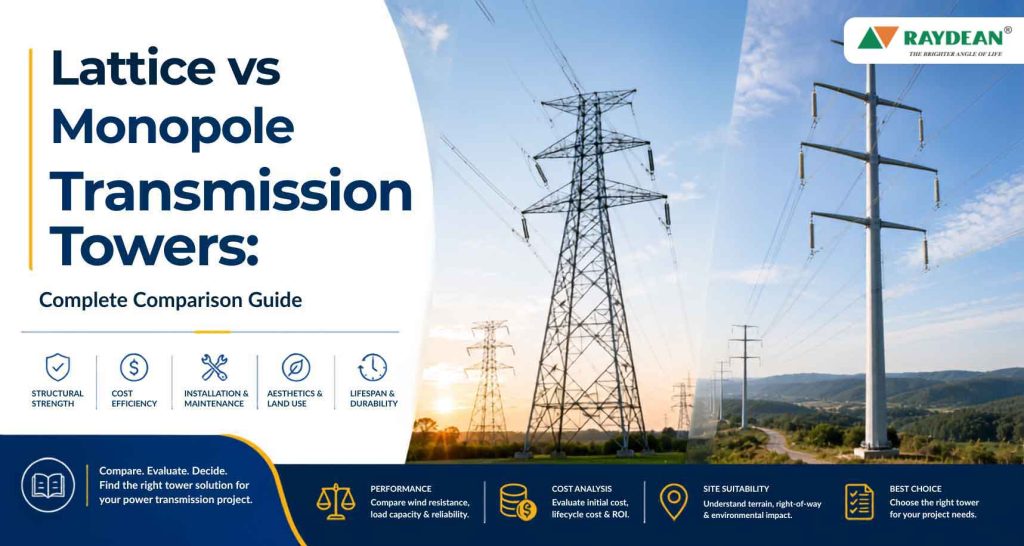
A lattice transmission tower is an open-frame steel structure made from interconnected members forming a triangulated framework. It provides high structural efficiency and can be customized for different heights, spans, conductor arrangements, and loading conditions.
Lattice towers are commonly used for long-distance and high-voltage transmission networks. They can support single-circuit, double-circuit, multi-circuit, suspension, tension, angle, and terminal applications.
What Are Monopole Transmission Towers?
A monopole transmission tower uses a single primary steel column with a compact footprint. It is particularly useful where land availability and right-of-way are limited.
Monopoles are often considered for urban and semi-urban corridors, roadside routes, space-constrained sites, and projects where visual impact needs to be minimized. Their suitability depends on structural and electrical requirements.
Lattice vs Monopole: Key Differences
Lattice towers offer high structural flexibility, multi-circuit capability, and suitability for long-distance transmission. However, they generally require more space and contain more individual members and connections.
Monopoles provide a slimmer profile and compact footprint, which can be advantageous in congested areas. They may also allow faster erection due to fewer major components, although transportation and foundation requirements can be more demanding.
Cost and Foundation Considerations
Tower cost should not be compared only by purchase price. Engineering, fabrication, galvanization, transportation, foundation, erection, right-of-way, maintenance, and inspection all contribute to total project cost.
Lattice towers can be economical for conventional large-scale transmission projects, while monopoles may offer advantages where land and corridor constraints are significant. Foundation design must always consider soil conditions, structural loads, and overturning requirements.
How to Choose the Right Tower
Before selecting a tower configuration, evaluate voltage level, circuit requirements, span length, wind loads, soil conditions, electrical clearances, terrain, right-of-way, installation logistics, corrosion protection, and lifecycle cost.
For Indian projects, choosing an experienced transmission tower manufacturer in India can provide engineering, manufacturing, galvanization, quality control, and customized fabrication support.
A reliable transmission line tower manufacturer India should have suitable production and technical capabilities. For demanding projects, a capable high voltage transmission tower manufacturer India is particularly important.
Transmission Towers in India
When selecting electrical transmission towers in India, consider applicable standards, voltage level, circuit configuration, wind loading, tower height, electrical clearances, foundation conditions, corrosion protection, and project lifecycle cost.
For projects involving transmission towers in Rajasthan, local wind conditions, soil characteristics, high temperatures, accessibility, and renewable-energy evacuation requirements should also be considered.
Why Choose Raydean?
Raydean provides custom-engineered transmission tower structures, including lattice and monopole configurations, for different transmission and infrastructure applications. The company focuses on engineering, galvanized steel structures, quality manufacturing, and project-specific solutions.
Conclusion
The choice between lattice and monopole transmission towers depends on project-specific structural, electrical, environmental, and economic requirements. Lattice towers provide flexibility for long-distance and multi-circuit networks, while monopoles offer a compact solution for space-constrained corridors.
Looking for a reliable transmission tower solution? Contact Raydean to discuss your project requirements.
Read More: Common Mistakes to Avoid When Selecting Solar Mounting Structures