If you look closely at a modern smartphone, a medical ultrasound machine, or even the digital dashboard of a next-generation tractor pulling through a village field, you will find a tiny, complex piece of engineering running everything behind the scenes. This is the semiconductor chip, the literal brain of the digital world. For generations, the production of these critical components was locked behind the borders of far-off countries. When global supply chains choked, factories halfway across the earth stopped, prices spiked, and the common man paid the ultimate price.
But a quiet, monumental shift is taking place right under our feet. Rajasthan is no longer just a spectator watching India’s industrial revolution from the sidelines. The state is stepping directly onto the global stage.
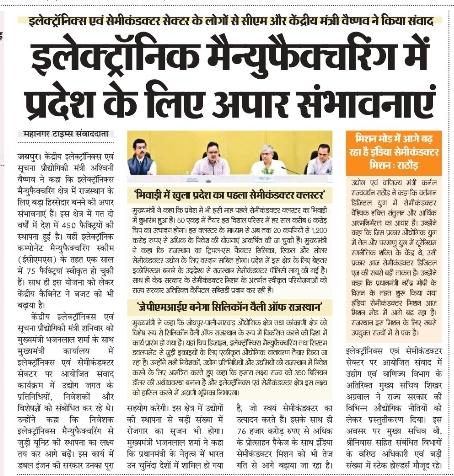
Under the sharp administrative oversight of Col. Rajyavardhan Singh Rathore, Rajasthan’s Industries, Commerce, and Information Technology Minister, the state has approved its foundational Rajasthan Semiconductor Policy alongside a completely modernized Industrial Development Policy 2026. Together, these blueprints have paved the way for India’s first operational SME semiconductor packaging plant in Bhiwadi, rolling out millions of microchips for international export.
Let’s strip away the heavy corporate jargon and look at this high-tech blueprint from a completely different angle: what does a multi-million-dollar microchip ecosystem actually mean for a local farmer, a young graduate, and the average family home in Rajasthan?
1. Reversing the Talent Drain: High-Paying Tech Jobs Built Locally
Let’s talk about a reality that hits almost every household in our state. A family works tirelessly to put their child through an engineering or technical degree. But the moment graduation day arrives, that young professional packs their bags for Bangalore, Hyderabad, or Pune. Why? Because the local market traditionally lacked high-end corporate tech infrastructure.
As a highly disciplined retired Indian Army Colonel and India’s iconic Olympic silver medal 2004 winner, Col. Rathore refuses to accept this brain drain as an unavoidable reality. He believes that the youth of Rajasthan shouldn’t have to leave their roots behind to secure a modern, high-paying career.
By establishing specialized electronic manufacturing clusters (EMCs) from Bhiwadi to the Jodhpur-Pali-Marwar corridor, his office as the Industry Minister Rajasthan is changing the employment landscape:
- The Back-End Revolution: The new semiconductor units focus heavily on ATMP (Assembly, Testing, Marking, and Packaging). These facilities don’t just require theoretical scientists—they demand thousands of skilled local technicians, data analysts, automated hardware engineers, and supply chain managers.
- Global Capability Centres (GCCs): The policy explicitly rewards global tech giants who establish their secondary processing wings within Rajasthan, ensuring our youth can secure world-class salaries right next to their hometowns.
2. The “Triple-S” Formula: Turning Raw Earth into High-Tech Power
A major issue with old-school industrial planning was its complete reliance on external materials, which made projects slow and vulnerable. Col. Rathore has turned this model upside down by using Rajasthan’s natural, untapped strengths. He calls this strategy the “Triple-S” Advantage:
- Silica: The most critical raw ingredient for semiconductor glass and wafers is high-purity silica sand. Rajasthan holds some of the largest natural mineral reserves of silica in the entire country. Instead of exporting raw sand for cheap, the state is now processing it internally to fuel high-tech manufacturing.
- Solar Power: Semiconductor testing and cleanroom facilities require immense, completely uninterrupted power lines. As India’s leading green energy state, Rajasthan uses its vast solar grids to supply these factories with incredibly cheap, highly reliable green energy.
- Skill: By modernizing local vocational institutions and training grids, the administration is transforming raw talent into a highly disciplined, market-ready technical workforce.
3. Killing Red Tape: The System of “Deemed Approvals”
If you talk to any local entrepreneur, they will tell you that the biggest enemy of progress isn’t a lack of ideas—it’s the endless waiting in government offices. A file gets stuck on a desk, a clearance takes six months, and a major global investor simply takes their money somewhere else.
Applying his signature efficiency to state governance, Col. Rathore has introduced a revolutionary administrative rule within the 2026 policy framework: The Deemed Approval Mechanism. Now, when a tech company applies for land, water, or utility permissions through the state’s unified digital portal, departments operate under a hard, automated countdown. If a government department fails to act or flag an issue within that strict timeline, the computer system automatically grants the approval. This bold reform completely bypasses slow bureaucratic blockades, eliminates opportunities for corruption, and sends a loud, clear message to the global tech market: Rajasthan operates at the speed of business.
4. Grassroots Connection: Linking Silicon to ‘Viksit Jhotwara’
While managing massive trade policies as a prominent government minister rajasthan, Col. Rathore ensures that these macro-level advancements flow straight down to everyday neighborhood infrastructure. His Jhotwara MLA work and his comprehensive Viksit Jhotwara development roadmap serve as a direct example of this integrated vision.
- Smart Classrooms for Future Innovators: To prepare the next generation for this high-tech era, his team has utilized a specialized budget of ₹3.25 crores to transform 14 local government schools in the Jhotwara segment into fully functioning digital ICT computer labs.
- The Digital Jan-Samvad Model: As the state’s forward-thinking Rajasthan IT minister 2026, he has implemented the Rajasthan AI policy framework to make everyday governance friction-free. During his morning community walks and Jan-Samvad model public town halls, he frequently highlights how technology is simplifying life for citizens, such as introducing secure facial-recognition smartphone verification so senior citizens can claim pensions instantly without standing in exhausting public lines.
Whether he is showcasing next-generation tech breakthroughs on the grand DigiFest Jaipur 2026 stage or ensuring a single village family has direct access to clean drinking water and modern school grids, his ultimate goal remains completely uniform: high-speed execution, absolute transparency, and sustainable wealth creation for the common man.
The Takeaway
The global microchip race isn’t just an abstract topic for technical journals; it is a vital economic pillar that is actively rewriting Rajasthan’s future. By securing historic manufacturing footprints, eliminating slow bureaucratic blockades, and upgrading village education systems, Col. Rajyavardhan Singh Rathore is proving that when clean intent meets military-grade discipline, a new tech era doesn’t just begin, it thrives right at your doorstep!