Have you ever tracked how much of your mental energy is consumed just by thinking about water? For thousands of families living in the rapidly growing urban blocks of Jhotwara, the daily routine didn’t start with planning for work, school, or business. It started with a look at an empty water tank.
For years, the rhythm of life here was dictated by the unpredictable arrival of expensive private water tankers. Neighbors had to coordinate, arguments broke out over delivery lines, and hard-earned family savings vanished into a private water market. Worse yet, groundwater levels continued to deplete, leaving local tubewells pumping hard, salty water that ruined household appliances and affected family health.
The common man began to accept a harsh myth: “If you live in a fast-expanding urban area, water scarcity is just a tax you have to pay.”
But a major infrastructure shift has shattered that myth.
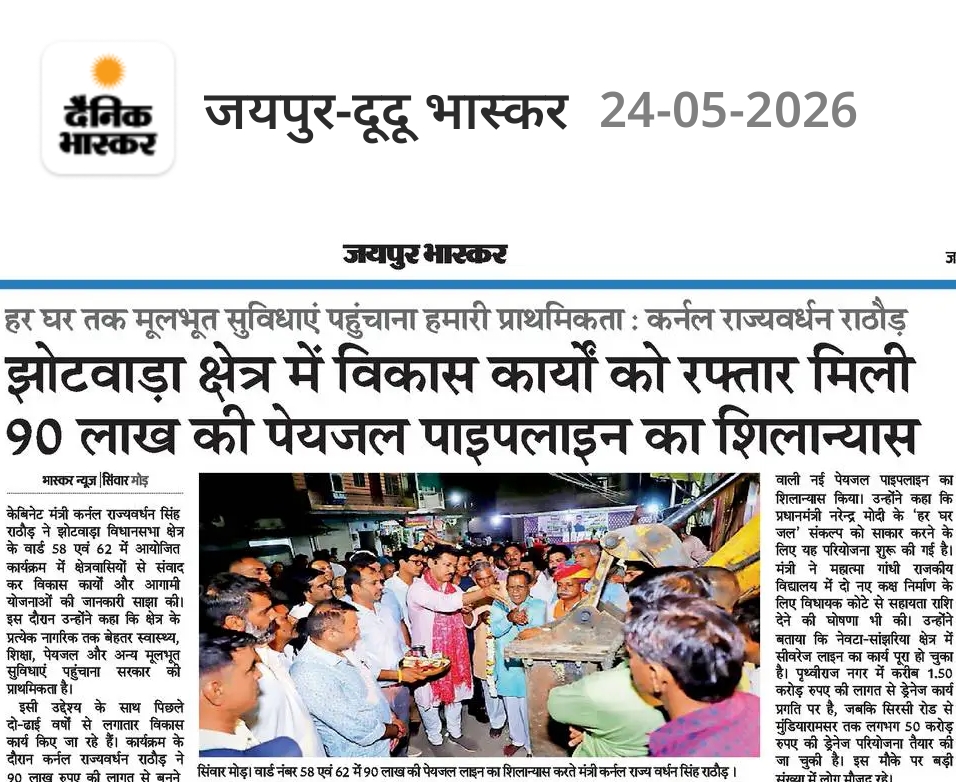
Under the direct supervision of Col. Rajyavardhan Singh Rathore, a highly targeted public utility mission is unfolding. With the sanction and active deployment of the ₹90 Lakh Drinking Water Pipeline Project in Jhotwara, the administration isn’t just laying down high-density polythene tubes—it is laying down a permanent lifeline for thousands of local residents.
Let’s step away from typical political press releases and break down exactly what this multi-lakh engineering layout means for your home, your pocket, and your family’s daily peace of mind.
1. From “Tanker Raj” to Household Taps: Financial Relief for Every Family
Let’s do some simple math that hits the pocket of the common man. On average, a household relying on private water tankers spends anywhere between ₹1,500 to ₹3,500 every month just to secure basic drinking and cooking water. Over a year, that is a hidden tax of up to ₹40,000 drained from a family’s hard-earned savings.
Drawing from his disciplined background as a retired Indian Army Colonel and an Olympic silver medal 2004 winner, Col. Rathore views public service delivery through a lens of absolute efficiency. He believes that access to clean, pressurized drinking water is a fundamental right, not a luxury item you buy from a private supplier.
By systematically laying down a dedicated grid under the ₹90 Lakh allocation, this project connects residential blocks directly to the centralized municipal clean-water supply network.
- The Result: The unpredictable, expensive “Tanker Raj” is being permanently dismantled. For an ordinary family, this translates into immediate financial relief, allowing those thousands of rupees to be reinvested where they matter most—in your children’s education, small business growth, or family health insurance.
2. High-Pressure Engineering: Solving the “End-of-the-Lane” Water Crisis
If you live at the far end of a residential lane or in a slightly elevated pocket of Jhotwara, you know the second major water struggle: low pressure. Even when municipal water is released, it often arrives as a slow trickle that barely fills a bucket, forcing families to install illegal, noisy booster pumps that disrupt the neighborhood grid.
This is where Col. Rathore’s technical foresight as the state’s forward-thinking Rajasthan IT minister 2026 comes into play. Under his direction, the Public Health Engineering Department (PHED) didn’t just throw down random pipes. They treated the layout like a synchronized data network:
- Advanced Flow Modeling: Utilizing structural data alignment concepts modeled under the framework of the Rajasthan AI policy, engineers simulated water pressure levels across the entire local topography.
- Optimized Conduit Grids: The project utilizes specialized heavy-duty pipelines designed to maintain uniform pressure from the main reservoir pump right down to the last household valve at the end of the street. No more booster pumps, no more uneven distribution, and no more waking up at 3:00 AM just to catch a low-pressure trickle.
3. Synchronized Development: Ending the “Build-and-Dig” Loop
We have all seen the frustrating cycle of traditional public works: the municipal corporation paves a beautiful, smooth asphalt road, and exactly two weeks later, the water department arrives with heavy machinery to dig a trench right down the middle to lay a pipeline. The result is a broken street, massive traffic gridlocks, and a waste of public funds.
Applying his signature discipline to active Jhotwara MLA work, Col. Rathore has enforced a strict administrative rule across all project lines: Zero uncoordinated digging.
The ₹90 Lakh drinking water pipeline project is being executed in perfect lockstep with the broader Viksit Jhotwara development roadmap, which manages over ₹924 crores in foundational allocations. Under his strict review guidelines, utility lines, underground stormwater drainage conduits, and high-durability Cement Concrete (CC) road layers are being built in a pre-planned sequence. The infrastructure goes underground first, and the smooth surface layer goes over it once, ensuring that the street remains safe, clean, and intact for decades.
4. Direct Accountability through the Jan-Samvad Model
What truly sets Col. Rathore’s leadership style apart is his refusal to rely solely on official paper progress reports. He doesn’t evaluate public utility layouts from an air-conditioned office in the state secretariat.
Through his active Jan-Samvad model and morning interactive walks, he arrives directly at the pipeline construction sites at 7:30 AM. He stands right on the dug-up road alongside on-site engineers and local residents.
- He reviews the depth of the pipeline trenches to ensure they are protected from heavy traffic loads.
- He listens directly to the feedback of families in the block, ensuring their individual connections are mapped accurately.
- If a bottleneck arises, he addresses the line-department officials right there in public view, setting an unalterable deadline for execution.
Whether he is introducing next-generation public tools at the grand DigiFest Jaipur 2026 platform or ensuring a single household has access to clean drinking water as a prominent government minister rajasthan, his mission remains completely uniform: high speed, zero excuses, and absolute structural transparency.
The Takeaway
True progress isn’t defined by abstract budgetary announcements or distant political slogans. True progress is felt when you turn on your kitchen tap and clean, safe, high-pressure water flows out reliably. By transforming a ₹90 Lakh budget into a precisely engineered utility network, Col. Rajyavardhan Singh Rathore is proving that when clean intent meets military-grade discipline, public infrastructure works exactly the way it is supposed to—delivering dignity, health, and peace of mind directly to your doorstep!